I am one of the lucky few women who don’t have painful periods.
Most of my friends with uteruses are experiencing significant amounts of pain, especially during the first day.
Unfortunately, medicine still treats women very unfairly when it comes to pain — especially period pain. Most women are told that their painful periods are just that, and they need to deal with it.
This is total BS.
Pain — especially severe pain — is how our bodies tell us something is wrong. Don’t let your doctor gaslight you into thinking that there’s nothing wrong with you when you physically can’t function every time you have your period. Find a new doctor who will actually listen to you and get all your labs done without arguing with you. A good GYN will look at your whole body, not just your period pain. They will send you for ultrasounds (external and internal), refer you to an endocrinologist (a specialist in hormonal health), and schedule your extended bloodwork. They might also send you to a few other specialists to get to the bottom of it.
On average, it takes about 7 years for a woman to get diagnosed with endometriosis, which is ridiculous. No one should live in debilitating pain for that long. Hopefully, science will bring better and less invasive ways to diagnose endo (like a
test from period blood) — for now, a surgical exploratory laparoscopic procedure is the best way to confirm whether endo has spread in your abdomen.
Each month for about a week, we walk around with an actively bleeding internal wound, so some amount of pain is normal. The “normal” pain, although unwelcome, most of us can live with and still function. That said, there are plenty of ways to make even that “normal” pain less burdensome.
Here are some simple things you can try on your own to lessen period pain. They may not only help you feel better but also save you money in the long run. (Damn pink tax.)
Where to start:
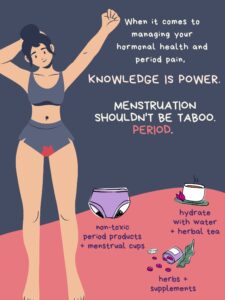
- Period underwear — research increasingly shows that switching to period underwear can significantly reduce cramps, and I can attest to that. I switched almost 10 years ago and never looked back. I went from being super angry with PMS and dreading the first day to pretty much forgetting I’m even on my period. Here are a few brands I like: Thinx, Saalt, Period, Volare Care, and Boody.
- Menstrual disc or cup — both can be worn for a long time, making them a great choice on busy days when you don’t know when you’ll have a bathroom break. They work best in combination with period underwear. Discs are also self-emptying, which is a big plus.
Did you know that period products were tested with real blood for the first time in 2025? If that is not insane, I don’t know what is. Even weirder: most big-name companies that produce period products for women are run by men. Period products also lack much regulation, so when it comes to quality and what goes into them, it’s anyone’s guess. Independent test results from most of those products have shown high amounts of harmful chemicals, including arsenic, bleach, phthalates, bisphenols, pesticides, heavy metals, microplastics, and perfume. None of those chemicals should be anywhere near our bodies, let alone inside our vaginas.
- Seed cycling — I’m linking an article here; it is one of the simplest things you can do for yourself. Food is potent medicine — this one takes time, but I think it’s worth a try, especially if it can help you regulate your hormones.
- Herbs — I’m linking a few herbal supplements I’ve tried myself: Cramp Care (definitely helps with painful cramps); For hormone support: Women’s Reproductive Health by Herb Pharm, Female Libido by Herb Pharm, Hormone Advantage by Thorne, Balance by Dr. Brighten; For perimenopause, all by Herb Pharm: Menopause Health, Black Cohosh, Chaste Tree, Dong Quai, Red Clover.
- Microplastics and environmental chemical exposure — this one requires the most time and some investment, but the rewards are worth it.
For the past 12 years, I have lived a zero-waste lifestyle. My exposure to environmental chemicals and chemicals from plastic is, at this point, pretty limited. Seeing how much my lifestyle changed my health (especially my reproductive health) for the better, over the years, I started developing a theory that plastic must have a huge impact on our hormones, especially on our reproductive system.
When I started my zero-waste journey, I was not expecting that limiting plastic use would have any impact on my health. I was pretty shocked when my cycle regulated on its own after about 6 months of reducing my plastic exposure. I dropped about 15 lbs, my skin cleared up, and my PMS just went away. It was a turning point.
Changing a lifestyle isn’t something that can be done overnight, and I don’t advise anyone trying to do so. What you can do is choose one thing at a time and stick to it. I will say tackling your bathroom first might be a good idea, since most of the plastic that affects our bodies is likely to be hidden there. Your creams, shower gels, shampoos, conditioners, plastic toothbrushes, and shavers are all products you can gradually replace with cleaner, plastic-free alternatives that will benefit your body and your wallet. (You can try these shops:
Humby Organics,
Leafe Shave,
Brush with Bamboo,
Zero Waste Store,
Mason Jar – brick and Mortar store in Williamsburg.)
I’m currently finishing a book titled
Count Down by Shanna H. Swan and Stacey Colino — and Netflix released a documentary titled “Plastic Detox” last year, with Dr. Shanna H. Swan, that covers much of the same ground.
If you haven’t read the book or watched the documentary, do yourself a favor and check it out, especially if you are trying to get pregnant.
Limiting your exposure to environmental hormone disruptors can help regulate your cycle and your metabolism. Things like plastic food containers, dish sponges, liquid shampoos, conditioners, shower gels, scented laundry detergents, scented cleaning products, plastic toothbrushes, and plastic shavers pretty much always contain bisphenols and phthalates — both potent endocrine disruptors.
The worst offenders here are synthetic home scents (including various wall-plug sprays, aerosols, and gels) and perfumes. These products contain hormone-disrupting chemicals, including phthalates, that persist in the air for long periods. Breathing those scents is never a good idea for our bodies. This is why candles and perfume are often a reason for migraines, sinus issues, and other health problems. (If you love a good scent and would like to find a cleaner, non-harmful option, read
this article.)Unfortunately, modern medicine very rarely considers environmental factors in our hormonal health. Chemicals in plastic can affect our bodies in profound ways. For example, BPA (
Bisphenol A — banned in baby bottles and some other plastic products) is still present in many cosmetic bottles, water bottles, heat-activated receipts, and other products. It is a serious hormone disruptor that wreaks havoc on our bodies, especially for women, and even more so during pregnancy. (Studies have shown that cashiers, who handle receipts frequently, have much higher rates of infertility — heat-activated receipt paper is coated with BPA.)
We’ve been told for too long to just push through the pain and accept it as part of being a woman. It doesn’t have to be that way. I’m not a doctor, and I’m not here to tell you what to do. I’m just a woman who started paying attention and couldn’t stop once I did. The connection between what surrounds us and how we feel is real, and the more we learn and talk about it, the harder it becomes to ignore the facts.
Share this with someone who needs it. Explore the links, start with small changes wherever they feel manageable, stay curious, and advocate for yourself loudly — your body will thank you.

Leave a Reply